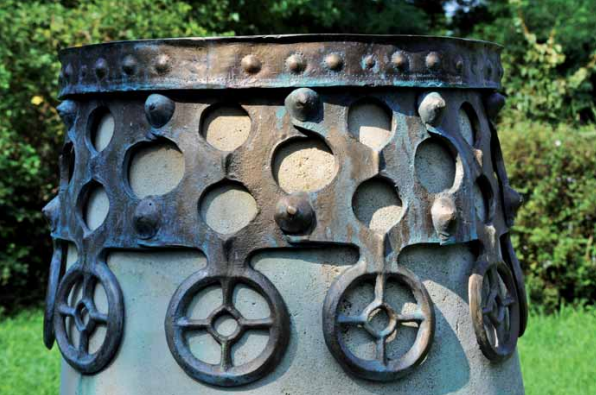
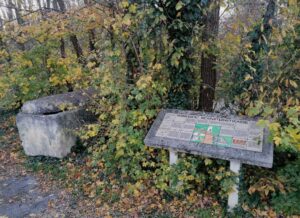
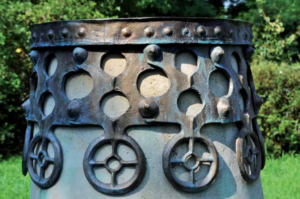
Early Bronze Age cult devices of Haschendorf and Balkåkra (South Sweden) show the manifold cultural and cult connections between Central Europe and the Baltic Region. Cult objects, which were buried at both sites independently of each other, all indicate a special function. The Haschendorf object was found in white lime sand in 1914, the corresponding object from Balkåkra was detected in a moor in 1847. The cult object of Haschendorf was found by the farmer Johann Widder on 12th March 1914, shortly before the outbreak of the First World War, when he was digging lime sand at the foot of Kräfteriegel. Today a copy of the bronze cult object, which was designed by Prof. Heinz Bruckschwaiger in June 2001, can be seen on this site. The original can be seen in the Soproni-Múzeum (Fabricius-House) in Sopron (Ödenburg). Johann Widder reported „his find“ to the curator for archaeology in Sopron, Mr. Johann Reinhard Bünker. The archaeological analysis revealed that the cult object had been deposited in a sand pit 2 metres beneath the surface. The cult object has a steeply conical bottom part with ten individually cast parts which hold an immobile spoke wheel and which are held together by cone rivets. A bronze band is riveted along the upper rim which carries a round bronze plate decorated with dots.